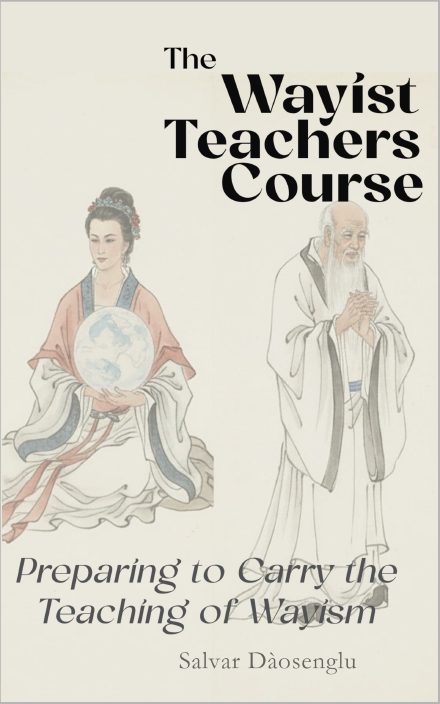
Wayism has no central authority. No board examines its teachers, no lineage stamps them, no one issues a licence. And yet the teaching has to be carried, whole and undiluted, to the person who is ready for it. This course is how that carrying is learned.
The Wayist Teachers Course is the formation of a teacher — not a set of beliefs to hold, but the training of someone who can state theWAY clearly, in their own voice, and stand behind every word of it. It comes from Salvar Dàosenglu, the consortium who prepared Primary Teaching Wayism, its interlinear, notes, and most of the shelf you will read from here. It brings you into their company on the only terms Wayism recognises: not certified, but trusted, because you have actually learned the teaching and can audit yourself honestly — which is itself the first lesson of the vocation.
Sixteen units take the whole teaching in order: who the human being is, the cosmos and the laws that run it, the anatomy of the mind, the energies, the unseen companions, the practice, the character it forms, and the ordinary life where all of it comes to ground. Then the teacher’s own craft — the mantras to put in a mouth, the poems to put in a mind, and the hard art of sitting beside a person in trouble without mistaking yourself for their saviour.
Nothing here asks to be believed before it has been tried. You are shown where the answers live, you take them in until they are your own, and you learn to say them plainly to whoever is in front of you. The course hands you the map; walking the ground is a life — which is, after all, the point.
A question you will be asked first
“What is Wayism?” — the shortest, most common, and most easily botched question a teacher will ever field, not because the answer is hard, but because it needs a home in your own mouth before the moment it’s actually needed. The course’s own answer, the one you’re coached to make yours:
It is a life philosophy and a lifestyle — an ancient existential philosophy, not a religion. Wayism holds that every human life is a journey of soul development — likened to a caterpillar’s transformation into a butterfly — in which souls incarnate to learn on Earth, a school of divinity, and eventually graduate into immortal spiritual beings. It is not a new invention; the same understanding recurs under different names across cultures and millennia. All humans are on this Path, and knowing it is not required in the lower grades. And it asks for no blind belief: the framework follows from observation and honest reflection, not faith alone.
Everything the rest of the course teaches is commentary on that.